

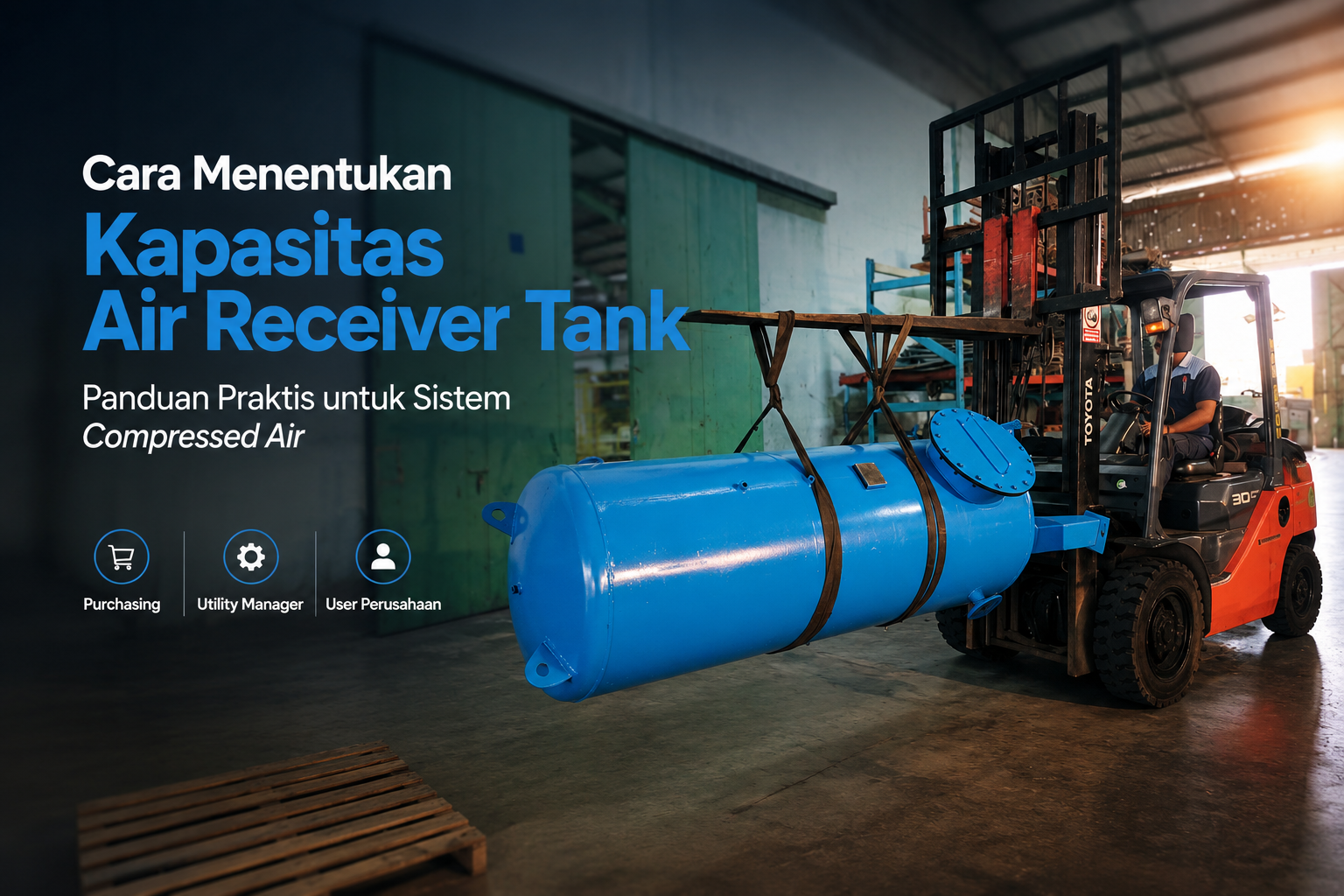

In many industrial facilities, an air receiver tank is often seen as just a storage vessel. In reality, choosing the right tank capacity plays a critical role in maintaining stable pressure, improving energy efficiency, and extending the lifespan of your air compressor system.
So, how do you determine the ideal air receiver tank size for your operation?
Why Is Air Receiver Tank Capacity Important?
An air receiver tank serves several important functions, including:
- Storing compressed air as a reserve supply.
- Stabilizing system pressure.
- Reducing compressor load/unload cycling.
- Assisting in cooling and condensate separation.
- Handling sudden peaks in air demand.
If the tank is too small, pressure fluctuations may occur and the compressor will cycle more frequently. On the other hand, an oversized tank can lead to unnecessary capital costs.
How to Determine Air Receiver Tank Capacity
One of the simplest and most widely used methods is to size the tank based on the compressor’s air flow capacity.
1. Systems with Stable Air Demand
As a general guideline:
Air Receiver Tank Capacity = 20–30% of the compressor’s free air delivery (FAD) per minute.
Example:
If your compressor delivers 10 m³/min, the recommended air receiver tank capacity would be:
- Minimum: 2 m³ (2,000 liters)
- Recommended: 3 m³ (3,000 liters)
This sizing is suitable for applications with relatively constant air consumption.
2. Systems with High Demand Fluctuations
For facilities experiencing sudden changes in air usage—such as automated production lines, packaging equipment, or intermittent high-demand processes—the receiver tank capacity can be increased to:
40–50% of the compressor’s free air delivery per minute.
A larger buffer helps maintain stable pressure during peak demand periods and reduces stress on the compressor.
Factors to Consider Before Selecting a Tank
Besides compressor capacity, several other factors should be evaluated:
- Air consumption patterns throughout production.
- Acceptable operating pressure range.
- Compressor control type (Fixed Speed or VSD).
- Future expansion plans.
- Available installation space.
Don’t Focus on Price Alone
For purchasing teams, selecting the lowest-cost option may not always deliver the best long-term value. For utility managers and end users, properly sized air receiver tanks contribute to system reliability, lower operating costs, and improved production efficiency.
Conclusion
Choosing the right air receiver tank capacity is not simply about selecting the largest or cheapest tank available. By understanding your compressor output and actual air demand, you can build a compressed air system that is more stable, efficient, and reliable.
Need help selecting the right air receiver tank for your facility? The Air Hira team is ready to evaluate your compressed air system and recommend the most suitable solution for your application.