

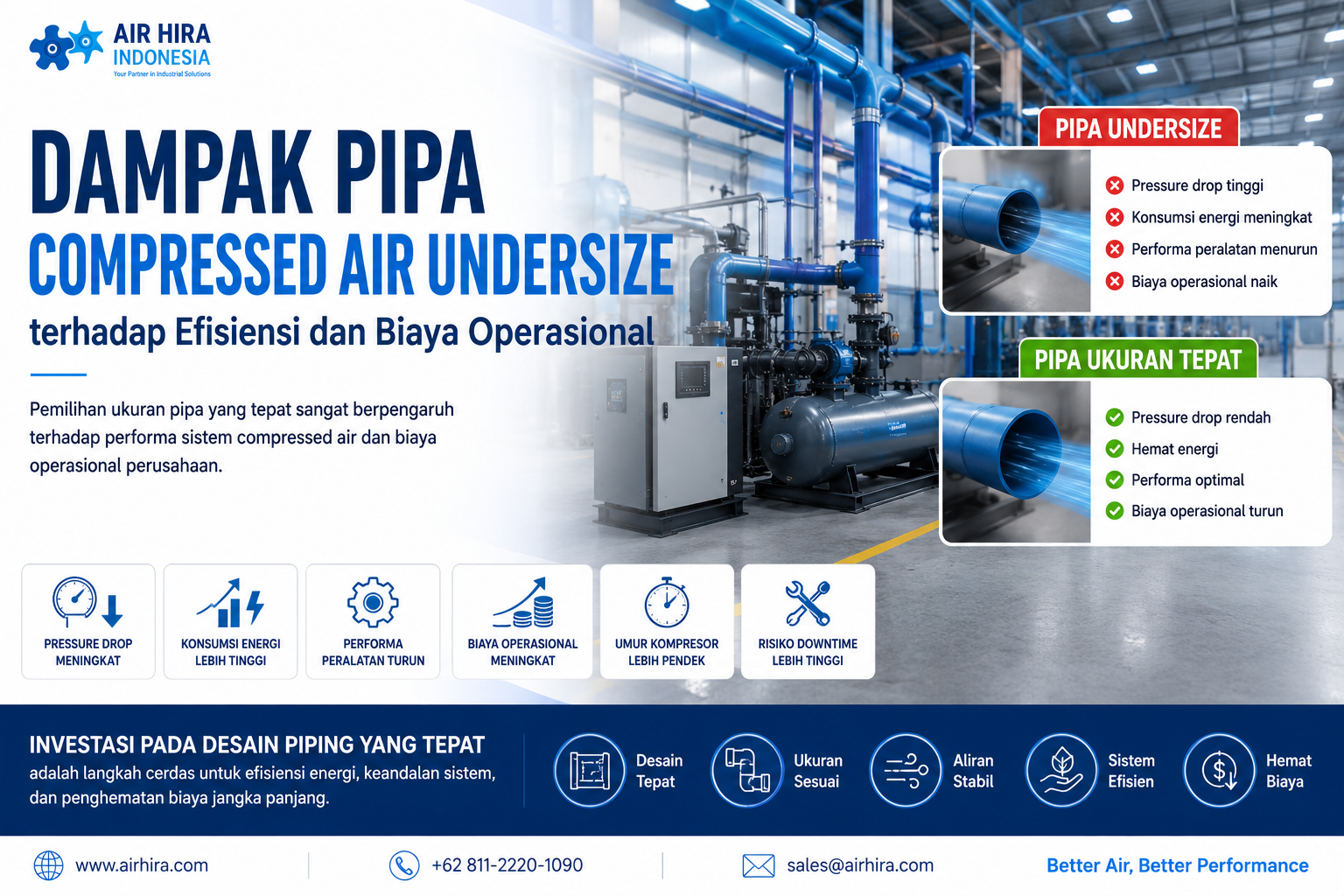

Many companies focus on selecting the right air compressor, but often overlook one critical part of the system—the compressed air piping network. One of the most common design mistakes is installing undersized piping, which can significantly reduce system performance.
Using piping with an insufficient diameter can lead to excessive pressure drop, higher energy consumption, and increased operating costs. For purchasing teams, utility managers, and plant operators, understanding the impact of undersized piping is essential to maintaining an efficient and reliable compressed air system.
1. Causes Excessive Pressure Drop
Pipes with a diameter that is too small create greater resistance to airflow.
As compressed air travels through the piping system, pressure gradually decreases before reaching the point of use.
The longer the pipeline and the more elbows, fittings, and valves installed, the greater the pressure loss.
2. Forces the Air Compressor to Work Harder
When pressure at the point of use drops, the compressor must generate higher discharge pressure to maintain production requirements.
This results in:
- Higher electricity consumption
- Longer compressor operating hours
- Increased mechanical stress on the compressor
Over time, this reduces overall equipment efficiency and reliability.
3. Increases Operating Costs
Every additional bar of compressor pressure requires more electrical energy.
With excessive pressure drop caused by undersized piping, companies pay higher electricity costs without gaining additional production capacity.
Proper piping design is one of the most effective ways to reduce long-term operating expenses.
4. Reduces Pneumatic Equipment Performance
Pneumatic cylinders, valves, actuators, and automated machinery require stable compressed air pressure to operate efficiently.
Insufficient pressure may lead to:
- Slower actuator movement
- Reduced machine performance
- Lower production quality
- Decreased productivity
Stable air pressure is essential for maintaining consistent manufacturing performance.
5. Limits Future System Expansion
An undersized piping system may be adequate today but can become a major limitation as production grows.
Adding new machines or increasing air demand may require costly piping modifications or complete system upgrades.
Designing the piping correctly from the beginning provides greater flexibility for future expansion.
How to Prevent Undersized Piping Problems
Several best practices can help improve compressed air distribution:
- Calculate airflow requirements before selecting pipe sizes.
- Choose piping diameters based on flow rate and installation length.
- Minimize unnecessary elbows and fittings to reduce pressure losses.
- Consider using a ring main piping system for more stable air distribution.
- Perform regular compressed air system audits to identify pressure drop and energy losses.
Proper Piping Design Delivers Long-Term Savings
Selecting the correct pipe size is not just about improving airflow—it is an investment in energy efficiency, equipment reliability, and lower operating costs.
A well-designed compressed air piping system helps reduce pressure loss, extend compressor life, improve production performance, and lower overall energy consumption.
PT Air Hira Indonesia provides professional services for compressed air system audits, compressed air piping installation, pressure drop analysis, leak detection, and compressed air system design consultation to help industries build reliable, energy-efficient, and high-performance compressed air systems.