

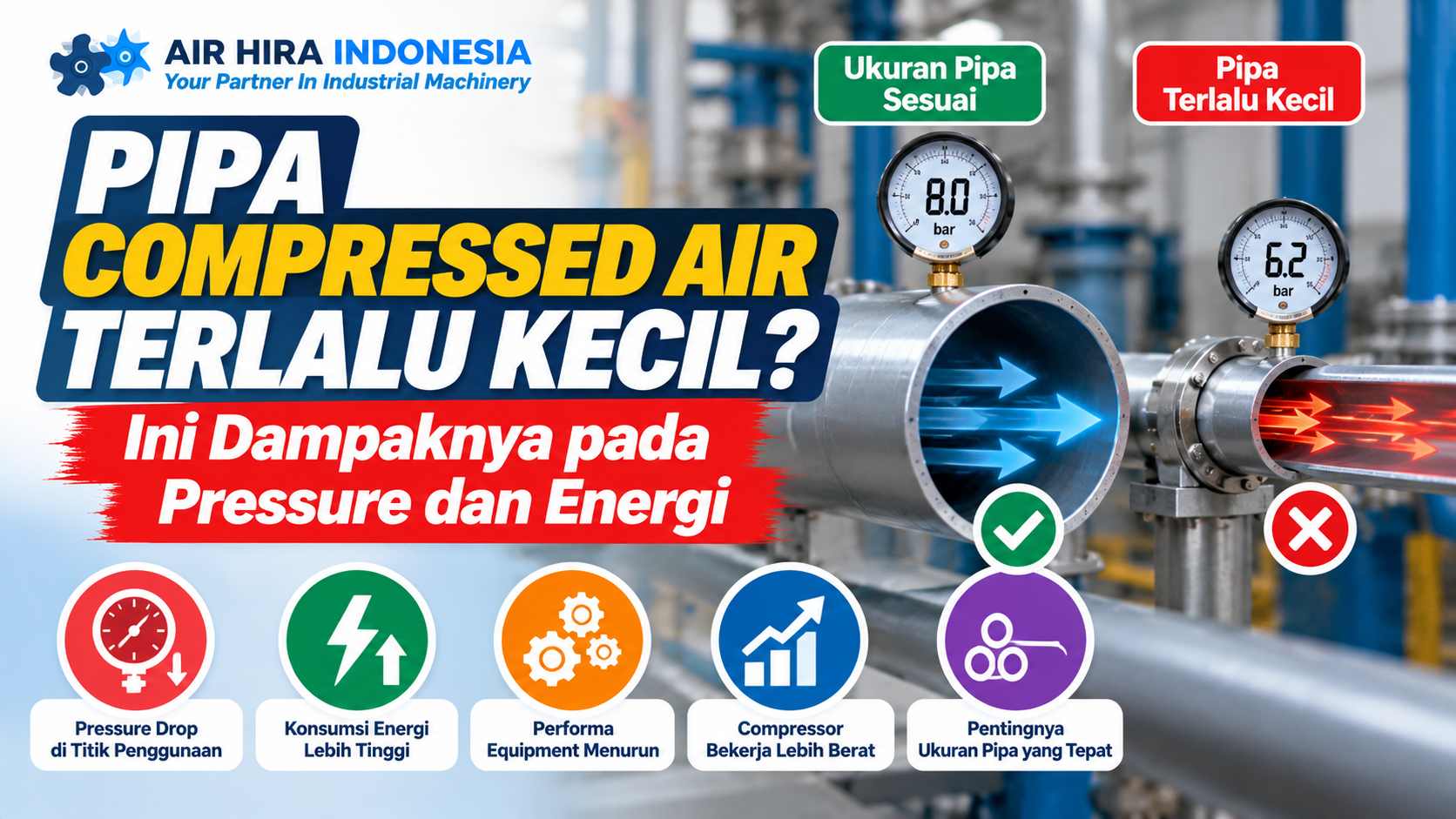

Using pipes that are too small for a compressed air system can cause pressure drop, restricted airflow, and higher operating costs. Even when the air compressor delivers the required pressure, the pressure at the point of use may be lower due to resistance within the piping network.
For Purchasing teams, Utility Managers, and industrial users, selecting the correct pipe size is essential to maintaining system performance and controlling energy consumption.
1. Pressure Drop at the Point of Use
An undersized pipe increases airflow velocity and flow resistance. As a result, pressure may drop along the piping network, especially when compressed air demand increases.
2. Higher Compressor Energy Consumption
To compensate for insufficient pressure, operators may increase the compressor pressure setting. However, operating at a higher pressure can increase electricity consumption without addressing the actual piping problem.
3. Reduced Equipment Performance
Unstable or insufficient air pressure can affect pneumatic tools, production machines, actuators, and other equipment that requires compressed air at a specific operating pressure.
4. How to Select the Correct Pipe Size
Compressed air pipe sizing should consider several important factors:
- Airflow demand (FAD): The total compressed air requirement of the system.
- Working pressure: The operating pressure required by the compressor and end-use equipment.
- Pipe length: Longer piping generally increases pressure loss.
- Fittings and valves: Elbows, tees, filters, and valves add flow resistance.
- Future expansion: Potential increases in production demand should also be considered.
Pipe material and network design can further influence overall system performance.
5. Measure and Evaluate System Performance
Measure the pressure at the compressor outlet and at the points of use while production is running. If the pressure difference is significant, inspect pipe diameter, leaks, filters, valves, and actual airflow demand.
A Compressed Air Audit can help identify the causes of pressure drop and determine whether the piping network needs modification or capacity upgrades.
Conclusion
Undersized compressed air pipes can cause pressure drop, reduced equipment performance, and energy waste. Proper pipe sizing should account for airflow demand, operating pressure, piping length, and future production requirements.
Air Hira Indonesia provides Compressed Air Audit, Flow Measurement, Leak Detection, Air Compressor Service, and Industrial Piping to help companies improve the reliability and energy efficiency of their compressed air systems.
Your Partner In Industrial Machinery 🌐 www.airhira.com 📱 WhatsApp: 08977600997